
Record your speech
Use of recordings
Users
The recordings will primarily be used by researchers studying speech and spoken communication in linguistics, communication studies, sociology and other disciplines, as well as researchers studying speech development and speech disorders.
The recordings will also be used by developers of language and speech technologies, such as speech recognition, automatic speech understanding and speech translation.
The recordings will also be available to anyone else wishing to use them for research or technology development.
Speaker anonymity
Speakers will be identified by anonymous codes that do not reveal their identity. The first and last names of speakers, or of the parents or guardians of minors, as well as contact details, will not be published together with the recordings. They will be accessible only to the collection administrators for the purposes of managing the database, handling individuals’ rights and administering the prize competition.
The recordings and transcripts will be linked to information about the recording circumstances and to the speakers’ anonymous codes.
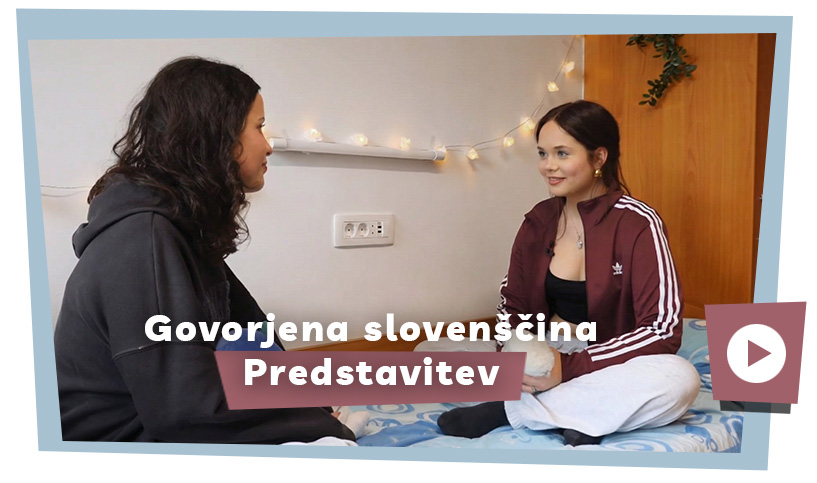
The video is in Slovenian and presents the purpose of this portal and how the contributed recordings are used.
Processing of recordings
The recordings will form part of a Slovene speech database. Transcripts of the speech heard in the recordings may be added to the recordings.
The transcripts may be further annotated with information about pronunciation, word forms, sentence structures, meaning, emotional tone and other features.
Access to recordings
Recordings from the Slovene speech database will be available through CLARIN.SI, the national repository for language resources and technologies. The database will be available for download under an open licence, such as a Creative Commons licence.
Individual utterances in the recordings will also be accessible through specialised search tools for language resources known as concordancers. An example of this type of access is the Gos spoken corpus, which is available through the CJVT concordancer, CLARIN noSketch Engine and CLARIN Kontext.
Privacy Statement for the Spoken Slovene Portal
(Articles 13 and 14 of the GDPR)
The controller of personal data processed through the Spoken Slovene portal is the Institute of Electronics and Telecommunications, Faculty of Electrical Engineering and Computer Science, University of Maribor (UM FERI), Koroška cesta 46, 2000 Maribor, Slovenia.
Contact details for the Data Protection Officer are available here: https://www.um.si/o-univerzi/dokumentno-sredisce/varstvo-osebnih-podatkov/
The Spoken Slovene portal is intended for collecting recordings of everyday spoken Slovene and making them publicly available for speech research, the development of digital tools for the Slovene language, and the preservation of our linguistic and cultural heritage. Anyone aged 15 or over may register as a portal user.
UM FERI processes the following personal data relating to portal users:
- first and last name and email address of the registered user who records and uploads a recording to the portal
- contact email address and other contact details
- automatically assigned ID of each submitted recording
- number of speakers in the recording
- language and language variety used in the recording
- place and region where the recording was made
- setting in which the speakers were recorded (e.g. at home in the living room)
- genre and type of speech (e.g. casual conversation)
- date of recording
- communication channel
- information about the device used to make the recording
- description of the situation in which the recording was made and of the recording process, including who was present (without giving names), the relationships between the speakers, the instructions they were given, and similar information
- notes on any particular aspects of the recording, the speakers’ participation and behaviour, observations concerning language or speech, and similar information
- keywords that may assist with searching, description or categorisation
- speech transcript
Of the data listed above, first and last names and contact details will not be published together with the recordings. They will be accessible only to the collection administrators for the purposes of managing the database, handling individuals’ rights, analytics and administering the prize competition.
UM FERI additionally processes the following data relating to speakers appearing in the recordings:
- first and last name
- gender
- age, including whether the speaker is a child
- educational attainment
- first language
- bilingualism from birth
- description of the bilingual situation
- any developmental, health-related or other characteristics affecting language and/or speech
- current place and municipality of residence
- place and municipality of residence during childhood or at birth
- any additional place and municipality of longer-term residence
- other geographical and linguistic data derived from the information listed above
Of the data listed above, the speaker’s first and last name will not be published together with the recording but will be accessible only to the collection administrators for the purpose of managing speakers’ rights.
For some types of speaker data, particularly where special categories of personal data may be involved, such as health data requiring separate consent, speakers may choose not to answer individual questions.
Recordings are collected through the portal on the basis of the speakers’ consent. You may withdraw your consent at any time without affecting the lawfulness of processing carried out on the basis of consent before its withdrawal. Where consent concerns a child under the age of 15, a special form must be used on which a parent or guardian gives consent on behalf of the child. Where the child is at least 7 years old and is able to provide simplified consent themselves, the parent’s or guardian’s consent constitutes approval of the child’s consent.
The recordings may subsequently be added to the CLARIN.SI portal on the basis of legitimate interests in speech research, the development of digital tools for the Slovene language, and the preservation of our linguistic and cultural heritage. Additional information relating to the speech or the speaker, such as place of residence, educational attainment or bilingualism, is therefore also collected where it may affect speech and may be useful for machine-learning applications in the development of digital tools or for speech research.
For younger children, educational attainment is not comparable with that of adults. Therefore, the educational attainment of the parent or guardian who gives or approves consent may optionally be collected as a proxy variable.
In accordance with the purposes defined above, the recordings and associated data are retained indefinitely, until consent is withdrawn by a speaker in the recording or until a prohibition on further use is received from a person who, under the law governing inheritance, is a legal heir in the first or second order of succession.
If consent is withdrawn or the right to erasure is exercised, UM FERI will use reasonable technical measures to inform data controllers who have downloaded the collection of recordings from the portal that the data subject has requested the deletion of any links to those personal data, or any copies of them.
The recordings will primarily be used by researchers studying spoken Slovene in linguistics and related disciplines, as well as by developers of language and speech technologies seeking to provide support for the Slovene language.
The controller does not intend to transfer the recordings and associated metadata to a third country outside the EU. However, the recordings will be available for download via the web portal from anywhere in the world. The CLARIN.SI research repository is used to store the recordings and make them accessible.
You may request from the controller access to your personal data and other information about its processing, the rectification or erasure of your personal data and, in certain circumstances, restriction of processing and data portability. You may also object to further processing. If you are not satisfied with the processing of your personal data, you may lodge a complaint with the Information Commissioner of the Republic of Slovenia, https://www.ip-rs.si.